Who We Are
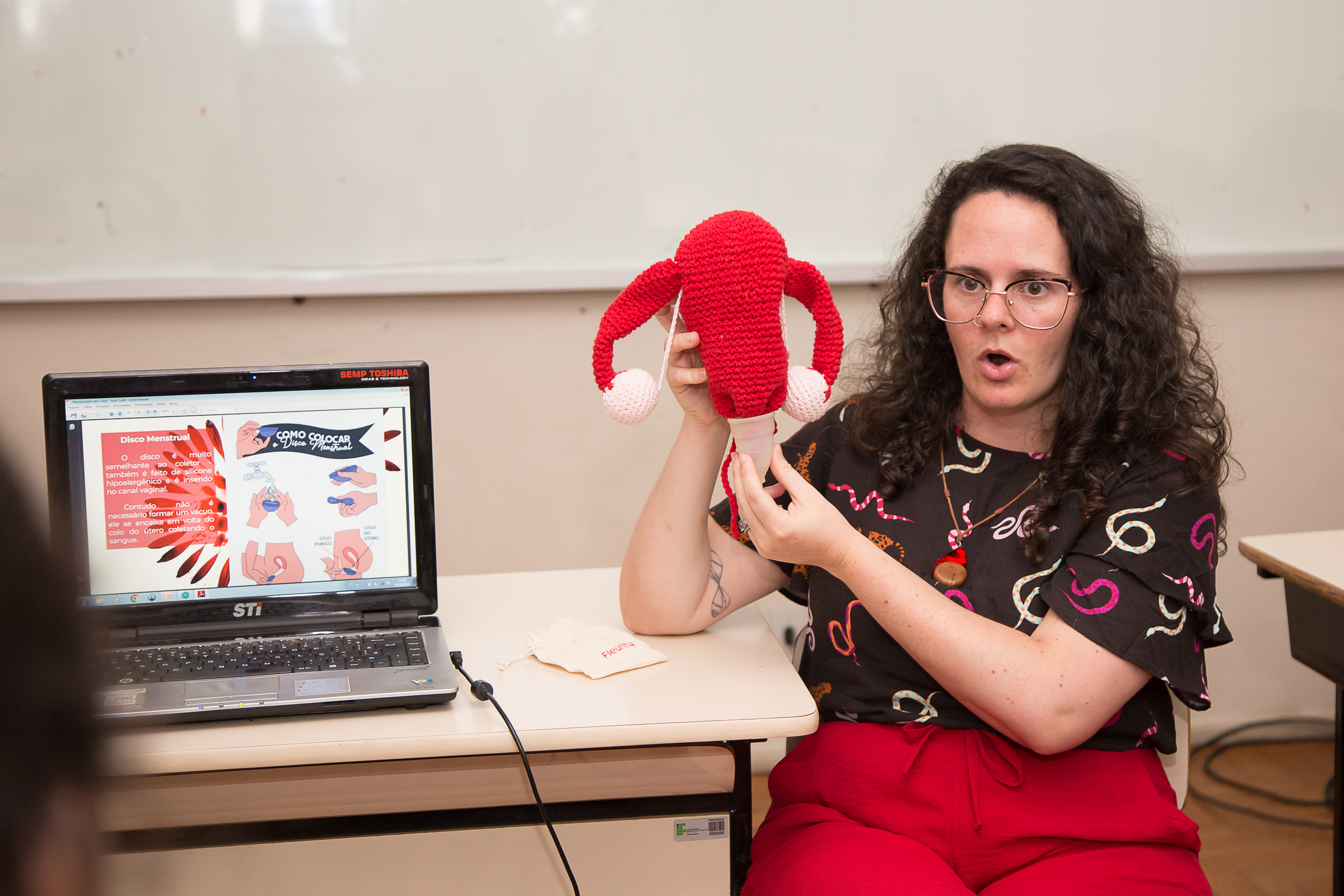
Menstruation Without Taboo is an initiative by Professor Dr. Janaina Morais, in collaboration with the Vertente Solidária NGO, with support from individual collaborators, NetRosas, CESE (Ecumenical Service Coordination), Libbs Farmacêutica, and Cimec.
Janaina Morais is an anthropologist, visual artist, and menstrual educator, with a PhD in Social Sciences from the Federal University of Juiz de Fora (PPGCSO-UFJF, 2021), with a focus on the Anthropology of Menstruation. For 16 years, she has researched topics such as gender, sexuality, the body, art, feminisms, intersectionality, politics, health, reproductive rights, autonomous gynecology, emotions, healing, experience, blood, menstruation, education, public policies, and menstrual dignity.
Since 2016, she has worked with Menstrual Education, offering courses, consulting services, and developing educational materials on the subject. She was a CNPq postdoctoral fellow at the Laboratory for Advanced Studies in Journalism (Labjor), linked to the Center for the Development of Creativity (Nudecri) at Unicamp, where she developed the research project “Menstrual Education in Schools: Impacts and Challenges in Promoting Menstrual Dignity,” which included a research stage in Mexico linked to Universidad Autónoma Metropolitana.
She currently works as a professor and coordinator of the “Menstruation Without Taboo” project. She is a member of the Laboratory of Socio-Anthropological Studies on Technologies of Life (Labirinto) at Unicamp, the Vazantes Collective - an autonomous collective for transdisciplinary production on/with menstruation - and the Red de Investigaciones Menstruales de América Latina y el Caribe.
Vertente Solidária NGO is a non-profit civil society organization, a private legal entity, whose activities focus on socioeconomic, educational, cultural, technological, environmental, and human development throughout Brazil, with its headquarters and legal jurisdiction in the city of Barbacena, Minas Gerais. Founded in 2001, it provided important services in the environmental field in Barbacena for several years and worked with the Brazilian Federal Government's Food Acquisition Program (PAA), entering into agreements to implement the program in Barbacena and the surrounding region. It currently develops two projects: “Esperançar,” which celebrates its fourth year this year and provides educational support to children in situations of social vulnerability; and “Menstruation Without Taboo,” which offers menstrual education workshops in schools and other institutions. Since 2026, it has been part of ReneDH - the National Network for Evidence in Human Rights, linked to the Ministry of Human Rights and Citizenship (MDHC).